Themes › Theme A Space, time and motion
A.1Kinematics
Kinematics is the description of motion: where something is, how fast it moves and how its velocity changes. It does not ask why things move. That comes in A.2 Forces and momentum.
Knowledge and science
Nature of science
Observations. For nearly 2000 years, people accepted Aristotle's idea that heavy objects fall faster than light ones. It matches everyday experience with stones and feathers. Galileo tested it by timing balls rolling down ramps and found that, without air resistance, everything falls with the same acceleration. Careful observation beat "common sense".
Measurement. Light gates, data loggers and high-speed video now let us measure motion far more precisely than a stopwatch. Better measurements let us test ideas more strictly.
Models. The equations of motion are a model. They assume constant acceleration and no air resistance. Within those limits they predict brilliantly, and outside them they fail. Knowing a model's limits is part of using it well.
ToK: questions to think about
- If a model is never exactly right, why trust it? Real accelerations are never perfectly constant, yet engineers rely on the equations of motion every day. When is a "wrong" model good enough, and who decides?
- Should we trust our intuition? Most people expect a ball fired horizontally to land after one dropped at the same moment, but they land together. If intuition can mislead us this badly, what role should it play in science?
- Does it matter if the story is true? The famous tale of Galileo dropping balls from the Leaning Tower of Pisa may never have happened. Does the history of how we came to know something matter, or only the knowledge itself?
- Can motion be captured in symbols? Four short equations can predict the flight of a ball or a space probe. What, if anything, is lost when we describe the world in mathematics?
1. Distance and displacement
To describe where an object is, we choose a reference point (the origin) and a positive direction. The object's position $x$ is how far it is from the origin, with a sign to show which side it is on.
- Distance is the total length of the path travelled. It is a scalar: it has size only, and it can never decrease.
- Displacement $s$ is the change in position, measured in a straight line from start to finish. It is a vector: it has size and direction, shown by its sign.
2. Speed and velocity
Velocity is the rate of change of position (displacement per unit time). It is a vector. Speed is distance per unit time, and it is a scalar. Both are measured in $\text{m s}^{-1}$.
For the walk above, if it took 10 s, the average speed is $13 \div 10 = 1.3$ $\text{m s}^{-1}$, but the average velocity is only $+3 \div 10 = +0.3$ $\text{m s}^{-1}$.
Average and instantaneous values
An average value is taken over a time interval. An instantaneous value is the value at one moment, like the reading on a car's speedometer. If you measure over shorter and shorter time intervals, the average velocity gets closer and closer to the instantaneous velocity.
On a displacement–time graph:
- the average velocity between two times is the gradient of the straight line (chord) joining the two points;
- the instantaneous velocity at one time is the gradient of the tangent to the curve at that point.
Chord PQ: gradient = average velocity between P and Q.
Tangent at P (dashed): gradient = instantaneous velocity at P.
3. Acceleration
Acceleration is the rate of change of velocity. It is a vector, measured in $\text{m s}^{-2}$. Using $u$ for the initial velocity and $v$ for the final velocity:
- A negative acceleration doesn't always mean "slowing down". It means the acceleration points in the negative direction. An object moving in the negative direction with negative acceleration is speeding up.
- Uniform (constant) acceleration: the velocity changes by the same amount every second. The velocity–time graph is a straight line.
- Non-uniform acceleration: the rate of change of velocity itself changes, for example a falling object affected by air resistance. The velocity–time graph is curved.
4. Motion graphs
Graphs are one of the most important tools in kinematics. Learn what the gradient and the area under the graph mean for each type:
| Graph | Gradient gives | Area under graph gives |
|---|---|---|
| displacement–time ($s$–$t$) | velocity | (nothing useful) |
| velocity–time ($v$–$t$) | acceleration | displacement |
| acceleration–time ($a$–$t$) | (not needed) | change in velocity |
Here are the three graphs for an object that starts from rest with constant acceleration:
Graph areas can be negative. On a velocity–time graph, area below the time axis is displacement in the negative direction. To find the distance, add the sizes of all the areas. To find the displacement, add them with their signs.
5. Equations of motion for uniform acceleration
When the acceleration is constant, five quantities describe the motion: $s$ (displacement), $u$ (initial velocity), $v$ (final velocity), $a$ (acceleration) and $t$ (time). These four equations, given in the data booklet, link them:
Where do they come from? Rearranging the definition of acceleration gives $v = u + at$. On the straight-line $v$–$t$ graph, the area under the line is a trapezium, so $s = \frac{(u+v)}{2}t$. Substituting $v = u + at$ into this gives $s = ut + \frac{1}{2}at^2$. Eliminating $t$ between the first two gives $v^2 = u^2 + 2as$.
A reliable method:
- Draw a quick sketch and choose a positive direction.
- List the values you know for $s, u, v, a, t$ (with signs) and the one you want.
- Pick the equation that contains your three known values and the one you want, and leaves out the quantity you neither know nor need.
- Substitute, solve, and give the answer with a unit, a sensible number of significant figures, and a direction if it's a vector.
Worked example: a braking train
A train travelling at 24 $\text{m s}^{-1}$ brakes with constant deceleration and stops in a distance of 160 m. Find (a) its acceleration and (b) how long it takes to stop.
Take the direction of motion as positive. Known: $u = 24$ $\text{m s}^{-1}$, $v = 0$, $s = 160$ m.
(a) $t$ is not known, so use $v^2 = u^2 + 2as$: $0 = 24^2 + 2a(160)$, so $a = -\dfrac{576}{320} = -1.8$ $\text{m s}^{-2}$.
The negative sign shows the acceleration is opposite to the motion: the train is slowing down.
(b) $v = u + at$: $0 = 24 + (-1.8)t$, so $t = 13$ s (13.3 s).
6. Free fall and measuring g
An object in free fall moves under gravity alone, with no air resistance. Near the Earth's surface, all objects in free fall have the same downward acceleration, whatever their mass:
If you take up as positive, then $a = -9.8$ $\text{m s}^{-2}$ for the whole flight: on the way up, at the top and on the way down. At the highest point the velocity is momentarily zero, but the acceleration is not zero.
Worked example: a stone thrown from a cliff
A stone is thrown vertically upwards at 12 $\text{m s}^{-1}$ from the edge of a cliff 25 m above the sea. Find (a) the time until it hits the sea and (b) its speed as it hits the water.
Take up as positive. Known: $u = +12$ $\text{m s}^{-1}$, $a = -9.8$ $\text{m s}^{-2}$, $s = -25$ m (the stone finishes 25 m below where it started).
(a) $s = ut + \frac{1}{2}at^2$: $-25 = 12t - 4.9t^2$, so $4.9t^2 - 12t - 25 = 0$.
Using the quadratic formula and taking the positive root:
(b) $v^2 = u^2 + 2as$ $= 12^2 + 2(-9.8)(-25)$ $= 634$, so $v = -25$ $\text{m s}^{-1}$. The speed is 25 $\text{m s}^{-1}$, and the negative sign shows it is moving downwards.
Determining g experimentally
A common school method:
- Drop a small steel ball from rest from a measured height $h$, using an electromagnet release and a trapdoor or light gate to time the fall $t$.
- Repeat each height several times and find the mean time. Then repeat for 5–8 different heights.
- Since $u = 0$, $h = \frac{1}{2}gt^2$. Plot $h$ against $t^2$. This should be a straight line through the origin with gradient $\frac{g}{2}$, so $g = 2 \times \text{gradient}$.
Video analysis is another good method. Film a falling object next to a metre rule, track its position frame by frame, and find $g$ from the gradient of the velocity–time graph. Air resistance and reaction time are the main sources of error. Using a dense, small ball and electronic timing reduces both.
7. Projectile motion
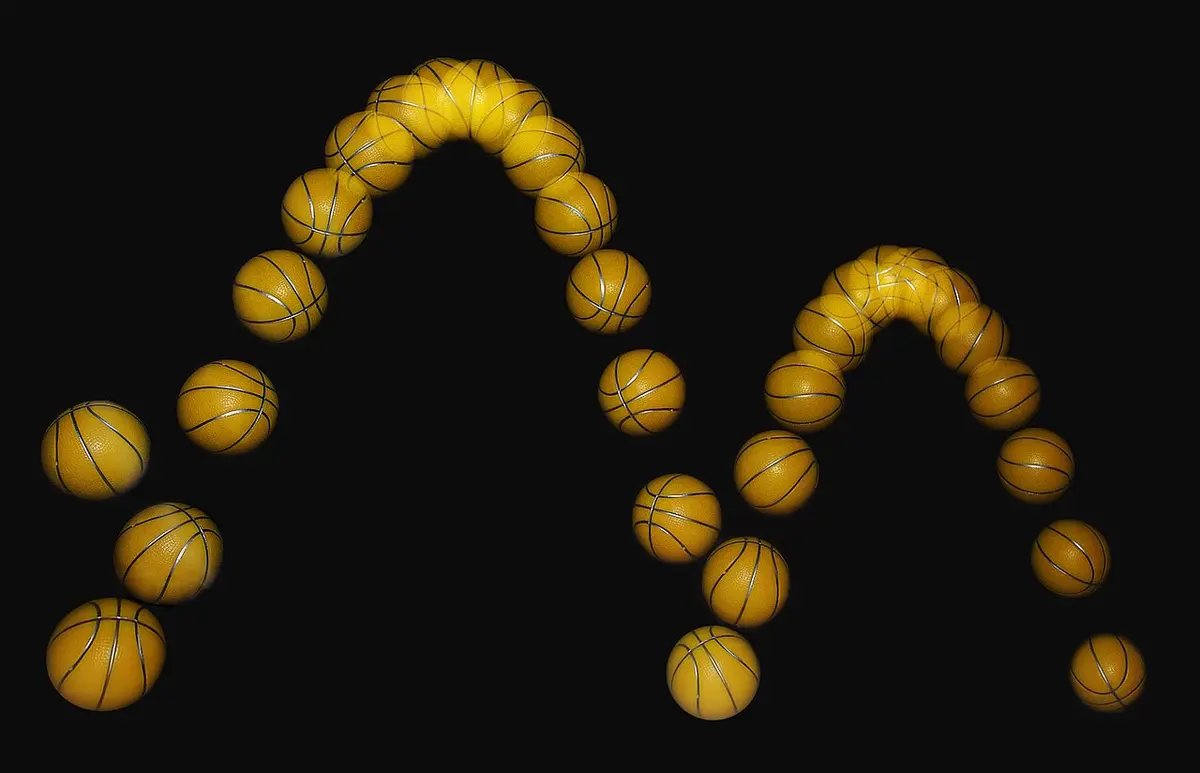
A projectile is an object that is launched and then moves under gravity alone, like a thrown ball. The key idea:
- Horizontally: no force, so no acceleration. The horizontal velocity $u_x$ stays constant, and $x = u_x t$.
- Vertically: constant acceleration $g$ downwards. Use the equations of motion with $a = -g$.
- Time $t$ is the only quantity the two directions share.
Start by resolving the launch velocity $u$ at angle $\theta$ above the horizontal:
Horizontal component: the same everywhere. Vertical component: decreases going up, zero at the top, increases going down.
Useful facts for a projectile launched from and landing on level ground:
- At the highest point, $v_y = 0$, but $v_x = u_x$ is not zero.
- The time to go up equals the time to come down.
- The range is $u_x \times$ (total time of flight).
- For a horizontal launch (for example, off a table), $u_y = 0$. The time to fall depends only on the height, not on the horizontal speed.
- For a launch at an angle below the horizontal (for example, a ball thrown downwards off a cliff), the method is the same. With up as positive, $u_y = -u\sin\theta$ is negative from the start, and there is no "highest point" after launch.
- To find the speed at any moment, combine the components: $v = \sqrt{v_x^2 + v_y^2}$, at angle $\tan^{-1}(v_y/v_x)$ to the horizontal.
Worked example: a football kicked from the ground
A football is kicked at 18 $\text{m s}^{-1}$ at 35° above horizontal ground. Ignore air resistance. Find (a) the maximum height, (b) the time of flight and (c) the range.
Components: $u_x = 18\cos 35° = 14.7$ $\text{m s}^{-1}$, $u_y = 18\sin 35° = 10.3$ $\text{m s}^{-1}$.
(a) At the top, $v_y = 0$. Use $v_y^2 = u_y^2 - 2gh$: $h = \dfrac{10.3^2}{2 \times 9.8} = 5.4$ m.
(b) Time to the top: $0 = 10.3 - 9.8t$, so $t = 1.05$ s. The flight is symmetrical, so the total time is $2.1$ s.
(c) Range $= u_x t = 14.7 \times 2.10 = 31$ m.
8. Relative velocity: an introduction
Every velocity is measured relative to something, called a frame of reference. Usually that's the ground, but it doesn't have to be. Sitting on a moving train, you are at rest relative to the train but moving at 30 $\text{m s}^{-1}$ relative to the platform. Both statements are correct.
The velocity of object A as seen by an observer moving with object B is:
Here $v_A$ and $v_B$ are both measured relative to the ground. Read $v_{AB}$ as "the velocity of A relative to B".
In one dimension
Choose a positive direction and give each velocity a sign. On a straight road, take east as positive:
- Car A drives east at 30 $\text{m s}^{-1}$ and car B drives east at 25 $\text{m s}^{-1}$. Then $v_{AB} = 30 - 25 = +5$ $\text{m s}^{-1}$. To the driver of B, car A seems to creep slowly forward.
- Car C drives west at 25 $\text{m s}^{-1}$, so $v_C = -25$ $\text{m s}^{-1}$. Then $v_{AC} = 30 - (-25) = +55$ $\text{m s}^{-1}$. Vehicles moving in opposite directions pass each other very fast, which is why head-on collisions are so serious.
In two dimensions
The same equation works, but now the velocities are vectors, so the subtraction is done with a vector diagram. Subtracting a vector is the same as adding the vector reversed: $v_A - v_B = v_A + (-v_B)$.
Worked example: two cars at a crossroads
Car A travels east at 20 $\text{m s}^{-1}$. Car B travels north at 15 $\text{m s}^{-1}$. Find the velocity of A relative to B.
Draw $v_A$ (east), then add $-v_B$ (15 $\text{m s}^{-1}$ south) tip-to-tail. The resultant is $v_{AB}$:
Size: $|v_{AB}| = \sqrt{20^2 + 15^2} = 25$ $\text{m s}^{-1}$. Direction: $\tan^{-1}\!\left(\dfrac{15}{20}\right) = 37°$ south of east.
So, to the driver of car B, car A seems to be moving at 25 $\text{m s}^{-1}$ in a direction 37° south of east.
HL In A.5 you will build on this idea with Galilean transformations and then special relativity. There, the same idea is written $u' = u - v$, where $u'$ is a velocity measured in a frame of reference that moves at velocity $v$.
9. Fluid resistance and terminal speed
Air and water push back on moving objects. This fluid resistance (drag) always acts opposite to the velocity, and it gets larger as the speed increases. In this topic you only need to describe its effects, not calculate them.
Falling objects and terminal speed
- When an object is released, its speed is zero, so there is no drag. Its acceleration is $g$.
- As it speeds up, the drag increases, so the resultant (net) downward force decreases. The object still speeds up, but its acceleration gets smaller.
- Eventually the drag becomes equal in size to the weight. The resultant force is zero, so the acceleration is zero and the velocity stays constant. This constant velocity is the terminal speed.
Effect on projectiles
Compared with the same launch in a vacuum, a projectile moving through air:
- reaches a lower maximum height, and reaches it sooner;
- has a shorter range, and usually a shorter time of flight;
- has a horizontal velocity that decreases instead of staying constant;
- follows a path that is no longer symmetrical: it comes down more steeply than it went up;
- has an acceleration that is not constant, and not simply $g$.
10. Common mistakes
- Mixing up distance and displacement, or speed and velocity. If the question says "velocity", give a direction or sign.
- Inconsistent signs. Choose a positive direction at the start and stick to it. If up is positive, then $g$ is negative.
- Using the equations of motion when the acceleration isn't constant. Use graphs instead.
- Saying the acceleration is zero at the top of a throw. Only the vertical velocity is zero there.
- Mixing horizontal and vertical quantities in one projectile equation. Only time links them.
- Using the gradient of a curve between two points when the question asks for an instantaneous value. Draw a tangent.
- Leaving the calculator in radians when resolving velocities.
11. Check your understanding
A cyclist rides once around a circular track of radius 50 m in 40 s. What are the average speed and the average velocity?
Distance $= 2\pi \times 50 = 314$ m, so the average speed $= 314 \div 40 = 7.9$ $\text{m s}^{-1}$. The cyclist ends where they started, so the displacement is zero and the average velocity is zero.
A ball is thrown straight up. What is its acceleration at the highest point?
$9.8$ $\text{m s}^{-2}$ downwards, the same as everywhere else in the flight. The velocity is zero at that instant, but it is still changing.
Two identical balls leave a table at the same moment. One is dropped and the other is pushed off horizontally at 3 $\text{m s}^{-1}$. Which lands first?
They land at the same time. Both start with zero vertical velocity and have the same vertical acceleration $g$, so their vertical motions are identical. The horizontal motion doesn't affect the vertical motion.
A boat points straight across a river and moves at 3.0 $\text{m s}^{-1}$ relative to the water. The river flows at 2.0 $\text{m s}^{-1}$. What is the boat's velocity relative to the riverbank?
Add the two velocities as vectors, at right angles: $\sqrt{3.0^2 + 2.0^2} = 3.6$ $\text{m s}^{-1}$, at $\tan^{-1}(2.0/3.0) = 34°$ downstream from the "straight across" direction. The boat drifts downstream as it crosses.
On a velocity–time graph, how do you find the distance travelled if part of the graph is below the time axis?
Work out each area separately and add their sizes, ignoring the signs. (Adding them with their signs gives the displacement instead.)