Themes › Theme C Wave behaviour
C.4Standing waves and resonance
Pluck a guitar string or blow across a bottle and you hear a clear note. Waves bounce back and forth and add up to a standing wave that doesn't seem to travel at all. This topic explains how standing waves form, which notes a string or pipe can play, and why pushing something at just the right rate (resonance) can shatter a glass or shake a bridge. There is no additional HL content in C.4.
Knowledge and science
Nature of science
Patterns and trends. Pythagoras is said to have noticed that strings whose lengths are in simple ratios, such as 2 : 1 or 3 : 2, sound pleasant together. This was one of the first times that a pattern in nature was described with numbers.
Models. The same mathematical model, a whole number of half-wavelengths fitting into a fixed length, describes strings, pipes, microwaves in an oven and even electrons in atoms.
Observations. In the 1780s Ernst Chladni sprinkled sand on vibrating metal plates. The sand collected along the nodes and made beautiful patterns, so an invisible standing wave became something you could see.
Global impact. Engineers now design bridges, tall buildings and aircraft so that their natural frequencies are far from the frequencies of wind, traffic, footsteps and earthquakes.
ToK: questions to think about
- Is music universal? Every culture makes music using strings, pipes or drums, and all of them rely on standing waves. Does physics explain why some notes sound good together, or is that cultural?
- Can we know what we can't picture? Electrons in atoms are described by standing-wave patterns, and string theory imagines standing waves in many more dimensions than we can see. What role do reason and imagination play when observation is impossible?
- Do words shape understanding? The IB says "first harmonic" rather than "fundamental", and musicians use different words again. Does it matter which name we use for the same idea?
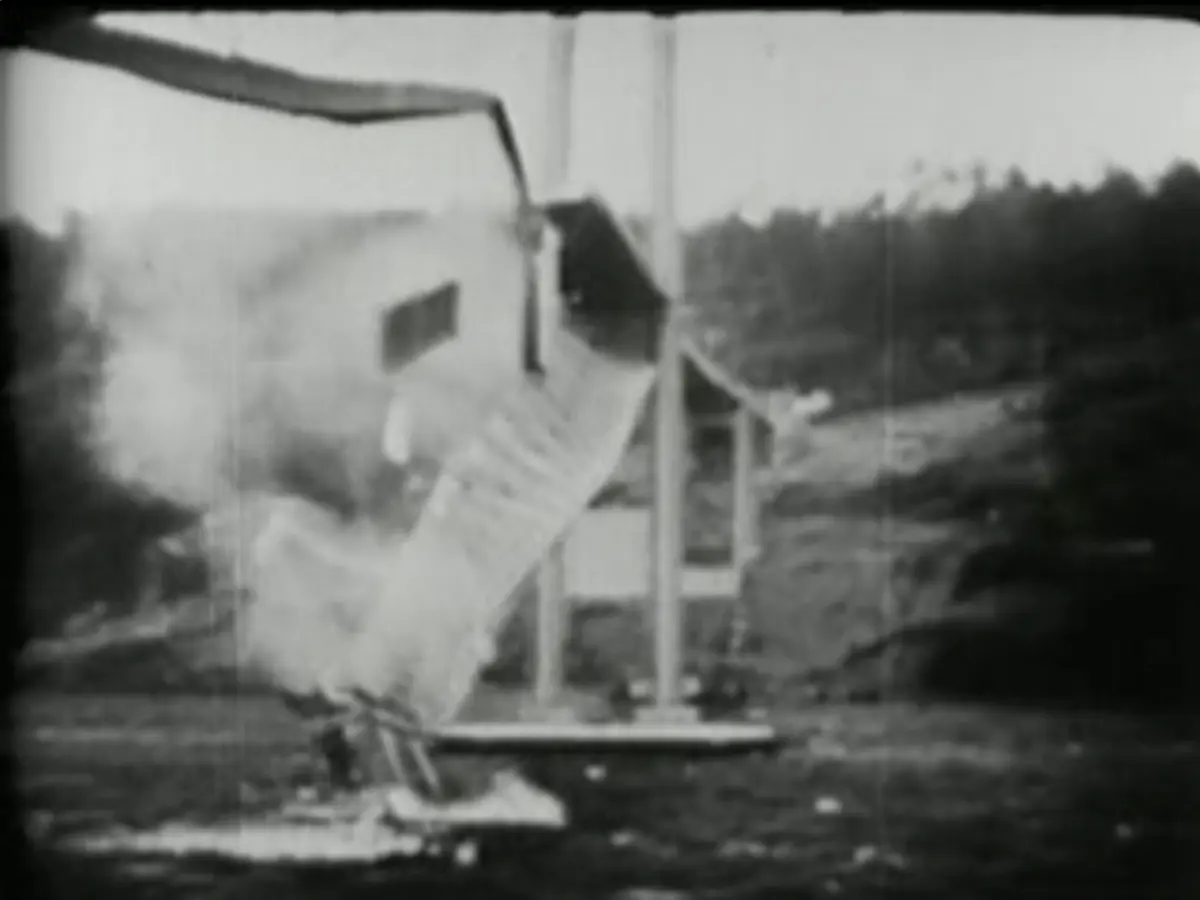
- Should we learn from failure? Some of what engineers know about resonance came from bridges that swayed dangerously. Is knowledge gained from accidents different from knowledge gained from planned experiments?
1. How standing waves form
A standing wave (also called a stationary wave) forms when two identical waves, with the same frequency, wavelength and amplitude, travel in opposite directions through the same medium and superpose (C.3). The usual way this happens is reflection: a wave travels to the end of a string or pipe, reflects, and meets the waves still arriving.
Compared with a travelling wave:
| Travelling wave | Standing wave | |
|---|---|---|
| Energy | transferred in the direction of travel | no net transfer: the two waves carry equal energy in opposite directions, so energy is stored in the oscillating medium |
| Amplitude | the same for every point | varies with position: zero at nodes, maximum at antinodes |
| Phase | changes steadily along the wave | all points between two neighbouring nodes are in phase; points either side of a node are in antiphase ($\pi$ apart) |
| Wave profile | moves along at speed $v$ | stays in the same place; it just grows, shrinks and flips |
| Frequency | every point oscillates at the same frequency (except nodes, which don't move) | |
2. Nodes, antinodes, amplitude and phase
- A node (N) is a point that never moves: the two waves always cancel there.
- An antinode (A) is a point that oscillates with the largest amplitude.
- Neighbouring nodes are half a wavelength apart, and so are neighbouring antinodes. A node and the nearest antinode are a quarter of a wavelength apart.
Phase: all the points in one loop move up together and down together, so they are in phase, even though their amplitudes are different. The neighbouring loop is always doing the opposite. So two points in neighbouring loops are in antiphase, with a phase difference of $\pi$ (180°).
Energy: every point oscillates at the same frequency, but with a different amplitude. Since the energy of an oscillation depends on its amplitude squared (C.1), points near antinodes have the most energy and nodes have none.
3. Standing waves on strings
A string can only vibrate in patterns that fit its boundary conditions, which describe what happens at the two ends:
- A fixed end, such as a guitar string clamped at the bridge, can't move, so it must be a node.
- A free end, such as a string tied to a light ring that slides on a smooth rod, moves the most, so it is an antinode.
Each pattern that fits is called a harmonic. The one with the lowest frequency is the first harmonic. The IB uses "first, second, third harmonic" and does not use the words "fundamental" or "overtone".
Both ends fixed
A whole number of half-wavelengths must fit into the length $L$. For the $n$th harmonic:
All harmonics are possible. These formulas are not in the data booklet: work them out from a sketch.
The wave speed $v$ on a string depends on its tension and on its mass per unit length. A tighter or lighter string carries faster waves and so plays higher notes. That's how a guitarist tunes a string, and why the thickest strings play the lowest notes.
Both ends free (antinodes at both ends) gives exactly the same wavelengths and frequencies, with the nodes and antinodes swapped over.
One end fixed, one end free
Now an odd number of quarter-wavelengths must fit into $L$, so only the odd harmonics exist:
The harmonic number tells you how many times the first-harmonic frequency it is. So the pattern after the first harmonic is the third harmonic, with three times the frequency. There is no second harmonic.
Worked example: a guitar string
A guitar string is 0.65 m long between its fixed ends. Its first harmonic has a frequency of 110 Hz. Find (a) the speed of waves on the string, (b) the frequency and wavelength of the third harmonic and (c) the first-harmonic frequency when the guitarist presses the string onto a fret so that the vibrating length is 0.49 m.
(a) First harmonic: $\lambda_1 = 2L = 1.30$ m, so $v = f\lambda = 110 \times 1.30 = 143\ \text{m s}^{-1}$.
(b) $f_3 = 3f_1 = 330$ Hz. $\lambda_3 = \dfrac{2L}{3} = 0.43$ m. (Check: $330 \times 0.433 = 143\ \text{m s}^{-1}$ ✓.)
(c) The tension and the string are unchanged, so $v$ is still 143 $\text{m s}^{-1}$: $f_1 = \dfrac{v}{2L} = \dfrac{143}{2 \times 0.49} = 146$ Hz. A shorter string plays a higher note.
4. Standing waves in pipes
Sound in a pipe is a longitudinal wave: the air molecules oscillate back and forth along the pipe. We describe the patterns using displacement nodes and antinodes. (The IB does not require pressure nodes and antinodes, and it ignores the small "end correction" at open ends.)
- At a closed end, the air is up against a wall and can't move: a displacement node.
- At an open end, the air is free to move in and out: a displacement antinode.
The pipes follow the same rules as strings:
- Open at both ends (antinode at each end, like a string free at both ends) and closed at both ends (node at each end, like a string fixed at both ends): $\lambda_n = \dfrac{2L}{n}$ and $f_n = \dfrac{nv}{2L}$, with all harmonics.
- Closed at one end and open at the other (like a string with one free end): $\lambda_n = \dfrac{4L}{n}$ and $f_n = \dfrac{nv}{4L}$, with odd harmonics only.
Worked example: open or closed?
A pipe is 0.85 m long, and the speed of sound in air is 340 $\text{m s}^{-1}$. Find the first three possible frequencies when the pipe is (a) open at both ends and (b) closed at one end.
(a) $f_1 = \dfrac{v}{2L} = \dfrac{340}{1.70} = 200$ Hz. All harmonics are possible: 200, 400 and 600 Hz.
(b) $f_1 = \dfrac{v}{4L} = \dfrac{340}{3.40} = 100$ Hz. Only odd harmonics: 100, 300 and 500 Hz.
Closing one end halves the lowest frequency, so the note drops by an octave. It also removes the even harmonics, which changes the sound's character (its "timbre"). That's one reason why different instruments sound different even when they play the same note.
Worked example: measuring the speed of sound with a resonance tube
A tuning fork of frequency 512 Hz is held over the open top of a tube of water. The water level is slowly lowered. The sound is loudest when the air column is 16.5 cm long, and next loudest at 50.0 cm. Find the speed of sound.
The tube acts as a pipe closed at the water surface. The two loudest positions are the first and third harmonics, $\frac{\lambda}{4}$ and $\frac{3\lambda}{4}$, so they differ by $\frac{\lambda}{2}$:
$\dfrac{\lambda}{2} = 50.0 - 16.5 = 33.5$ cm, so $\lambda = 0.670$ m and $v = f\lambda = 512 \times 0.670 = 343\ \text{m s}^{-1}$.
Using the difference between the two lengths is a good method: the antinode really sits slightly above the top of the tube, and subtracting cancels that error out. The frequency of the note stays at 512 Hz throughout, because the tuning fork sets it.
5. Summary of boundary conditions
| Ends | Wavelength of $n$th harmonic | Harmonics |
|---|---|---|
| node–node string fixed at both ends; pipe closed at both ends | $\lambda_n = \dfrac{2L}{n}$ | all |
| antinode–antinode string free at both ends; pipe open at both ends | $\lambda_n = \dfrac{2L}{n}$ | all |
| node–antinode string with one free end; pipe closed at one end | $\lambda_n = \dfrac{4L}{n}$ | odd only |
In every case, $f_n = \dfrac{v}{\lambda_n}$. If you forget a formula, sketch the pattern, count the quarter- or half-wavelengths, and work it out.
6. Natural frequency and resonance
Any object that can oscillate has a natural frequency $f_0$: the frequency at which it oscillates freely after being disturbed once and left alone. A swing, a mass on a spring, a wine glass and a bridge all have natural frequencies. Strings and pipes have many, one for each harmonic.
A driving force that pushes an object again and again at a driving frequency $f$ makes it oscillate at that frequency. This is a forced oscillation. Its amplitude depends on how close $f$ is to $f_0$:
- When $f$ is far from $f_0$, the pushes are often badly timed, working against the motion as often as with it. The amplitude stays small.
- When $f = f_0$, every push is in step with the motion. Energy is added on every cycle, and the amplitude grows to its maximum. This is resonance.
Why doesn't the amplitude keep growing forever? Real systems always lose some energy, for example to friction, air resistance or sound. The amplitude grows until the energy lost in each cycle equals the energy supplied in each cycle. Then it stays steady. This is conservation of energy at work.
Pushing a child on a swing is the classic example. If you push once per swing, just as it starts to move away from you, a small push builds up a large swing. Push at a random rate and the swing barely moves.
7. Damping
Damping is the loss of energy from an oscillating system, which makes the amplitude decrease. It is caused by resistive forces such as friction, air resistance and drag in a liquid. The IB uses three levels of damping:
- Light damping (underdamping): the system keeps oscillating, but the amplitude gradually decreases. The period stays almost the same. Example: a pendulum or a guitar string slowly dying away.
- Critical damping: the system returns to equilibrium in the shortest possible time without oscillating (it doesn't overshoot). Example: car shock absorbers, and doors that close smoothly without slamming.
- Heavy damping (overdamping): the system returns to equilibrium without oscillating, but more slowly than with critical damping. Example: a pendulum swinging in thick oil.
How damping changes resonance
A graph of amplitude against driving frequency is called a resonance curve. Damping changes its shape:
As the damping increases:
- the maximum amplitude decreases, because more energy is lost each cycle;
- the peak becomes broader (less sharp), so the system responds over a wider range of frequencies;
- the resonant frequency (the frequency of the peak) shifts slightly lower, below the natural frequency $f_0$. With light damping the shift is too small to notice.
Damping does not change the natural frequency $f_0$, which depends only on the system itself (for example $m$ and $k$ for a mass on a spring). It changes how the system responds to a driving force.
At very low driving frequencies the amplitude is small but not zero: the system simply follows the slow pushes. At very high driving frequencies it can't keep up, and the amplitude falls towards zero.
8. Useful and destructive resonance
Useful resonance
- Musical instruments: strings, air columns and drum skins resonate at their harmonics. The hollow body of a guitar resonates too, which makes the sound louder.
- Tuning a radio: the receiving circuit is adjusted until its natural frequency matches the station's frequency, so it responds strongly to that one signal.
- Quartz clocks and watches: a tiny quartz crystal is kept vibrating at its natural frequency, which is extremely steady and keeps accurate time.
- MRI scanners: nuclei in the body are made to resonate with radio waves, producing detailed images without X-rays.
- The greenhouse effect (B.2): molecules such as CO2 and H2O have natural vibration frequencies in the infrared. They absorb infrared radiation from the Earth at these frequencies, which warms the atmosphere.
Destructive resonance, and how it is reduced
- Bridges and footbridges: wind, marching soldiers or crowds of walkers can drive a bridge near its natural frequency. London's Millennium Bridge swayed so much when it opened in 2000 that it was closed two days later. Dampers were added before it reopened.
- Buildings in earthquakes: buildings whose natural frequency matches the ground shaking suffer most. Tall buildings such as Taipei 101 use huge tuned mass dampers to reduce swaying.
- Machines and vehicles: engines, washing machines and helicopter rotors can make parts vibrate violently at certain speeds. Rubber mounts and careful design add damping.
- Breaking glass: a loud note at a glass's natural frequency can make it vibrate so strongly that it shatters.
9. Common mistakes
- Saying a standing wave transfers energy. It doesn't: the two travelling waves carry equal energy in opposite directions.
- Taking the node-to-node distance as one wavelength. It's half a wavelength. Node to the next antinode is a quarter.
- Saying all points in a standing wave have the same amplitude. That's true for a travelling wave, not a standing wave.
- Calling the second pattern of a pipe closed at one end the "second harmonic". It is the third harmonic, because its frequency is $3f_1$. Even harmonics don't exist for that pipe.
- Mixing up the ends of pipes. Closed end: displacement node (the air can't move). Open end: displacement antinode.
- Using "fundamental" or "overtone". The IB uses "first harmonic", "second harmonic" and so on.
- Thinking the frequency changes when the length changes in a resonance-tube experiment. The tuning fork sets the frequency. Changing the length changes which lengths resonate.
- Saying damping changes the natural frequency. It lowers and broadens the resonance peak, and shifts the resonant (peak) frequency slightly down, but the natural frequency stays the same.
- Confusing critical and heavy damping. Both return to equilibrium without oscillating. Critical damping is the fastest; heavy damping is slower.
10. Check your understanding
Two points on a standing wave are in neighbouring loops. What is the phase difference between them?
$\pi$ radians (180°). They are in antiphase: when one moves up, the other moves down. Any two points in the same loop are in phase.
A string fixed at both ends has nodes 0.20 m apart when vibrating in its fourth harmonic. How long is the string, and what is the wavelength?
Node to node is half a wavelength, so $\lambda = 0.40$ m. The fourth harmonic has four loops, so $L = 4 \times 0.20 = 0.80$ m.
A pipe closed at one end has a first harmonic of 150 Hz. What are the next two frequencies at which it resonates?
Only odd harmonics are possible: 450 Hz (third harmonic) and 750 Hz (fifth harmonic). There is no resonance at 300 Hz.
Why are car shock absorbers designed to be critically damped?
After a bump, the car returns to its normal position as quickly as possible without bouncing up and down. With light damping it would keep bouncing; with heavy damping it would take a long time to settle, so the next bump would arrive before it recovered.
A system is driven at its natural frequency. Why does its amplitude stop increasing after a while?
The energy lost each cycle (to friction, air resistance and so on) increases as the amplitude grows. The amplitude stops increasing when the energy lost each cycle equals the energy supplied by the driver each cycle.