D.2Electric and magnetic fields + HL extra
Rub a balloon on your hair and it sticks to the wall; hold a compass near a wire carrying current and the needle swings. Both are field effects. This topic describes electric charge and the forces between charges, maps electric and magnetic fields with field lines, and finds the uniform field between charged plates. HL students go on to electric potential and equipotential surfaces (sections 10–13), the electric twins of the gravitational ideas in D.1.
Knowledge and science
Nature of science
Experiments and evidence. Around 1909–1913, Robert Millikan and Harvey Fletcher balanced tiny charged oil drops in an electric field. Every drop carried a whole-number multiple of the same small charge: direct evidence that charge is quantised.
Models. Michael Faraday pictured "lines of force" filling the space around charges and magnets. Many scientists saw them as just a drawing aid, but Maxwell turned Faraday's field picture into equations that predicted electromagnetic waves.
Patterns and trends. Coulomb's law for charges and Newton's law for masses have exactly the same inverse-square form. Spotting patterns like this across different areas of physics is a powerful way to build understanding.
Evidence from interpretation. Millikan discarded some drops he thought were unreliable. Historians still debate whether that was good judgement or bias, a reminder that data always involves interpretation.
ToK: questions to think about
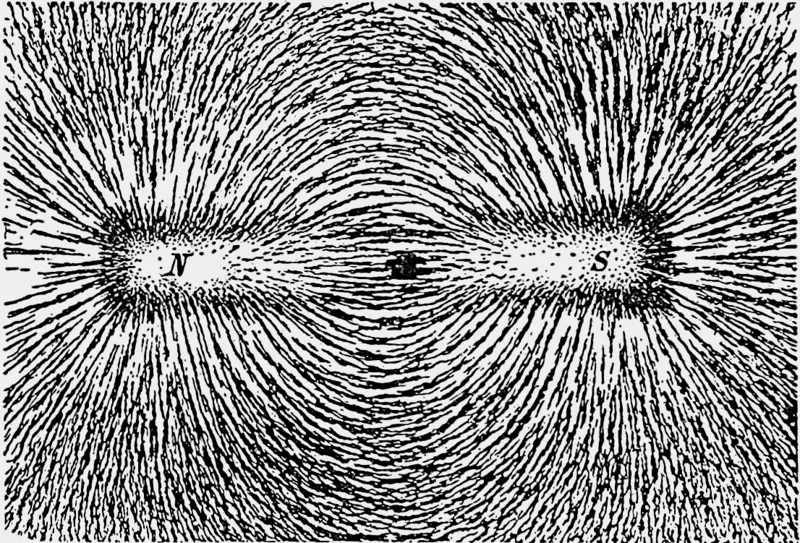
- Are field lines real? Iron filings line up along magnetic field lines, yet a field line is something we invent to draw a field. Is a useful representation the same as a true description?
- When is it acceptable to reject data? Millikan left some measurements out of his published results. How do scientists decide which data to trust, and who checks that decision?
- Why do different forces follow the same law? Gravity and electrostatics both follow inverse-square laws. Is this similarity a feature of nature, or of the way we choose to describe it?
- Can conventions mislead? Field lines point the way a positive charge would move, and conventional current flows from + to −, even though electrons usually do the moving. What are the benefits and dangers of keeping such conventions?
1. Electric charge and Millikan's experiment
There are two types of electric charge, positive and negative. Like charges repel; unlike charges attract. Electric charge is:
- conserved: the total charge of an isolated system never changes. Charge can move from one object to another, but it can't be created or destroyed;
- quantised: it always comes in whole-number multiples of the elementary charge $e = 1.60 \times 10^{-19}$ C. An electron has charge $-e$ and a proton $+e$.
Millikan's oil-drop experiment
A fine spray of oil drops is charged by friction as it leaves the nozzle. The drops fall between two horizontal metal plates. A potential difference across the plates creates a uniform electric field that pushes the charged drops up. By adjusting it until a drop hangs still, the electric force balances the weight:
$$qE = mg \qquad\Rightarrow\qquad q = \frac{mg}{E} = \frac{mgd}{V}$$(The mass of a drop was found from its terminal speed when falling with the field switched off.) Every charge measured was a whole-number multiple of $1.6 \times 10^{-19}$ C, and never a fraction of it.
Worked example: counting electrons on a drop
An oil drop of mass $3.0 \times 10^{-15}$ kg is held stationary between plates 8.0 mm apart when the p.d. is 490 V. Find the charge on the drop, and how many electrons it has gained.
$E = \dfrac{V}{d} = \dfrac{490}{8.0 \times 10^{-3}} = 6.1 \times 10^4\ \text{V m}^{-1}$.
$q = \dfrac{mg}{E} = \dfrac{3.0 \times 10^{-15} \times 9.8}{6.125 \times 10^4} = 4.8 \times 10^{-19}$ C.
$\dfrac{4.8 \times 10^{-19}}{1.60 \times 10^{-19}} = 3$, so the drop has 3 extra electrons. The top plate must be positive to pull the negative drop upwards.
2. Charging by friction, contact and induction
- Friction: rubbing two different insulators together transfers electrons from one to the other. Rub a balloon on wool and electrons move onto the balloon: the balloon becomes negative and the wool equally positive.
- Contact: touching a charged object to a neutral conductor lets some charge flow onto it, so both end up with the same sign of charge.
- Electrostatic induction: a charged object brought near (not touching) a conductor makes its free electrons move, separating the charges. If the conductor is briefly connected to the Earth, it can be left with an overall charge of the opposite sign.
Grounding (earthing) means connecting an object to the Earth. The Earth is so large that it can take in or give out electrons without its own charge changing noticeably, so a grounded conductor is discharged. That's why fuel tankers are earthed before refuelling and why buildings have lightning conductors.
3. Coulomb's law
The force between two point charges $q_1$ and $q_2$ a distance $r$ apart is:
$k = 8.99 \times 10^9\ \text{N m}^2\,\text{C}^{-2}$ is the Coulomb constant, and $\varepsilon_0 = 8.85 \times 10^{-12}\ \text{C}^2\,\text{N}^{-1}\,\text{m}^{-2}$ is the permittivity of free space. Like gravity, it is an inverse-square law; unlike gravity, it can attract or repel. A positive answer means repulsion.
A charged sphere acts on charges outside it as if all its charge were at its centre, so $r$ is again measured between centres.
Permittivity
When the charges are in a material rather than a vacuum, the force is smaller. We replace $\varepsilon_0$ with the permittivity $\varepsilon$ of the material: $F = \dfrac{q_1q_2}{4\pi\varepsilon r^2}$.
| Medium | Permittivity |
|---|---|
| vacuum | $\varepsilon_0$ |
| air | $1.0006\,\varepsilon_0$ (treat as $\varepsilon_0$) |
| paper | about $3\,\varepsilon_0$ |
| glass | about $5$–$10\,\varepsilon_0$ |
| water | about $80\,\varepsilon_0$ |
Worked example: atoms, gravity and water
(a) In a hydrogen atom, the electron and proton are about $5.3 \times 10^{-11}$ m apart. Compare the electric and gravitational forces between them. ($m_e = 9.11 \times 10^{-31}$ kg, $m_p = 1.67 \times 10^{-27}$ kg.) (b) By what factor is the force between two ions reduced when they are in water instead of a vacuum?
(a) $F_E = \dfrac{ke^2}{r^2} = \dfrac{8.99 \times 10^9 \times (1.60 \times 10^{-19})^2}{(5.3 \times 10^{-11})^2} = 8.2 \times 10^{-8}$ N.
Top: $Gm_em_p = 6.67 \times 10^{-11} \times 9.11 \times 10^{-31} \times 1.67 \times 10^{-27} = 1.01 \times 10^{-67}$. Bottom: $r^2 = (5.3 \times 10^{-11})^2 = 2.81 \times 10^{-21}$.
$F_G = \dfrac{Gm_em_p}{r^2} = \dfrac{1.01 \times 10^{-67}}{2.81 \times 10^{-21}} = 3.6 \times 10^{-47}$ N.
The electric force is about $2 \times 10^{39}$ times stronger. Gravity is irrelevant inside atoms; it only dominates for huge, electrically neutral masses such as planets.
(b) $F \propto \dfrac{1}{\varepsilon}$, so the force is about 80 times weaker. That's one reason salt dissolves in water: the attraction holding the ions together is greatly reduced.
4. Electric field strength
A charge creates an electric field around it. The electric field strength $E$ at a point is the force per unit charge on a small positive test charge placed there:
$E$ is a vector, measured in $\text{N C}^{-1}$ (the same as $\text{V m}^{-1}$). Its direction is the direction of the force on a positive charge. For a point charge $Q$, combining with Coulomb's law gives $E = \dfrac{kQ}{r^2}$.
A negative charge in the field feels a force in the opposite direction to $E$. Fields from several charges add as vectors.
Worked example: the field between two charges
A charge of $+4.0\ \mu$C is 0.30 m from a charge of $-2.0\ \mu$C. Find the electric field strength at the point midway between them.
Each charge is 0.15 m away. From the $+4.0\ \mu$C charge: $E_1 = \dfrac{8.99 \times 10^9 \times 4.0 \times 10^{-6}}{0.15^2} = 1.6 \times 10^6\ \text{N C}^{-1}$, pointing away from it (towards the negative charge).
From the $-2.0\ \mu$C charge: $E_2 = 8.0 \times 10^5\ \text{N C}^{-1}$, pointing towards it (the same direction).
Both point the same way, so they add: $E = 2.4 \times 10^6\ \text{N C}^{-1}$, towards the negative charge.
5. Electric field lines
Field lines show the direction of the force on a positive test charge. They start on positive charges and end on negative ones, never cross, and are closer together where the field is stronger. They meet the surface of a conductor at right angles.
- Single point charge: radial lines, outwards from a positive charge and inwards to a negative one.
- Charged conducting sphere: outside, the field is radial, exactly like a point charge at the centre. Inside, the field is zero: the charge spreads over the outer surface, and the fields from it cancel everywhere inside.
6. The uniform field between parallel plates
Two parallel metal plates with a potential difference $V$ between them produce a uniform field in the space between them: parallel, equally spaced field lines from the positive plate to the negative plate. Near the edges the lines bulge outwards and the field is weaker: these are edge effects.
$V$ is the potential difference between the plates and $d$ their separation. The field strength is the same everywhere between the plates (away from the edges), so a charge there feels the same force $qE$ wherever it is.
Worked example: an electron between plates
Two plates 2.0 cm apart have a p.d. of 500 V. Find the field strength, and the force on and acceleration of an electron between them ($m_e = 9.11 \times 10^{-31}$ kg).
$E = \dfrac{500}{0.020} = 2.5 \times 10^4\ \text{V m}^{-1}$.
$F = eE = 1.60 \times 10^{-19} \times 2.5 \times 10^4 = 4.0 \times 10^{-15}$ N, towards the positive plate.
$a = \dfrac{F}{m} = \dfrac{4.0 \times 10^{-15}}{9.11 \times 10^{-31}} = 4.4 \times 10^{15}\ \text{m s}^{-2}$. Its weight ($\approx 9 \times 10^{-30}$ N) is completely negligible.
7. Work in a uniform field and the electronvolt
When a charge $q$ moves through a potential difference $V$, the work done on it is $W = qV$ (B.5). For particles such as electrons and protons, joules are inconveniently large, so we often use the electronvolt:
An electron accelerated through 500 V gains 500 eV of kinetic energy, which is $500 \times 1.60 \times 10^{-19} = 8.0 \times 10^{-17}$ J. A particle with charge $2e$ (such as an alpha particle) accelerated through the same p.d. gains twice as much: 1000 eV. You'll use electronvolts a lot in D.3 and in Theme E.
8. Magnetic field lines
Magnets and electric currents create magnetic fields. Magnetic field lines show the direction a compass needle's north pole would point. Outside a magnet they run from its north pole to its south pole; they form closed loops, never cross, and are closer together where the field is stronger. The magnetic field strength is $B$, measured in tesla (T).
On diagrams, a field or current coming out of the page is drawn as a dot (⊙) and one going into the page as a cross (⊗), like looking at the tip or the tail of an arrow.
For a straight wire, use the right-hand grip rule: grip the wire with your right hand, thumb pointing along the conventional current; your fingers curl in the direction of the magnetic field. Reversing the current reverses the field.
For a coil or a solenoid, curl the fingers of your right hand in the direction of the current round the loops; your thumb points along the field inside, towards the north-pole end. Looking at the end of a solenoid, if the current flows anticlockwise, that end is a north pole.
9. Comparing fields
- Gravitational and electric fields both obey inverse-square laws: $g = \dfrac{GM}{r^2}$ and $E = \dfrac{kQ}{r^2}$. Mass and charge play matching roles.
- Gravity only attracts, because there is only one kind of mass; electric forces attract or repel. Electric forces between particles are vastly stronger, but large objects are usually neutral, so gravity dominates at the scale of planets.
- Magnetic field lines always form closed loops: there are no magnetic "charges" (monopoles). Cut a magnet in half and you get two smaller magnets, each with N and S poles.
- Magnetic fields are produced by moving charges (currents), and they exert forces only on moving charges (D.3).
10. Electric potential energy HL
As in D.1, the electric potential energy of a system is the work done to assemble it from infinite separation. For two point charges:
There's no built-in minus sign: $E_p$ takes its sign from the charges. Like charges give a positive $E_p$ (work must be done to push them together); unlike charges give a negative $E_p$ (they attract, so energy is released as they come together).
Worked example: two charges HL
Find the electric potential energy of a $+3.0\ \mu$C charge and a $-2.0\ \mu$C charge 5.0 cm apart. How much work is needed to separate them completely?
Top: $kq_1q_2 = 8.99 \times 10^9 \times (3.0 \times 10^{-6}) \times (-2.0 \times 10^{-6}) = -5.39 \times 10^{-2}$ J m.
$E_p = \dfrac{kq_1q_2}{r} = \dfrac{-5.39 \times 10^{-2}}{0.050} = -1.1$ J.
To separate them, $E_p$ must rise to zero, so 1.1 J of work must be done on the system.
11. Electric potential HL
It is a scalar, measured in volts ($\text{J C}^{-1}$), with zero at infinity. It is positive near a positive charge and negative near a negative charge. $E_p = qV_e$.
Because potential is a scalar, the potential due to several charges is just the sum of their individual potentials, each with its sign. No vectors are needed.
Worked example: four charges on a square HL
Charges of $+2.0\ \mu$C, $+2.0\ \mu$C, $+2.0\ \mu$C and $-2.0\ \mu$C sit at the corners of a square of side 0.20 m. Find the potential at the centre, and the work needed to bring a $+1.0$ nC charge there from far away.
Each corner is $\dfrac{0.20}{\sqrt{2}} = 0.141$ m from the centre. Adding the four potentials:
$V = \dfrac{k}{r}(2.0 + 2.0 + 2.0 - 2.0) \times 10^{-6} = \dfrac{8.99 \times 10^9 \times 4.0 \times 10^{-6}}{0.141} = 2.5 \times 10^5$ V.
$W = q\Delta V = 1.0 \times 10^{-9} \times 2.5 \times 10^5 = 2.5 \times 10^{-4}$ J.
The electric field at the centre is not zero (the fields from opposite corners don't all cancel). Finding it would need vector addition, but the potential needs only addition.
12. Potential gradient and work done HL
The field strength is the negative of the potential gradient: the field points from high potential to low potential. For a uniform field this gives $E = \frac{V}{d}$ (section 6).
Charged conducting spheres
For a charged conducting sphere of radius $R$ (solid or hollow, the result is the same, because the charge sits on the outer surface):
- inside: $E = 0$, so the potential is the same everywhere inside, equal to its value at the surface, $\dfrac{kQ}{R}$;
- outside: $E = \dfrac{kQ}{r^2}$ and $V = \dfrac{kQ}{r}$, as for a point charge at the centre.
Worked example: a charged dome HL
A metal sphere of radius 0.10 m carries $+5.0$ nC. Find the potential and field strength at its surface, at its centre, and 0.30 m from its centre.
Surface: $V = \dfrac{8.99 \times 10^9 \times 5.0 \times 10^{-9}}{0.10} = 450$ V and $E = \dfrac{kQ}{R^2} = 4500\ \text{V m}^{-1}$.
Centre: $E = 0$ and $V = 450$ V (the same as the surface).
At 0.30 m: $V = 150$ V and $E = 500\ \text{V m}^{-1}$.
13. Equipotential surfaces HL
An equipotential surface joins points at the same potential. As in gravitational fields:
- no work is done moving a charge along an equipotential;
- field lines are always perpendicular to equipotentials;
- drawn at equal steps of potential, equipotentials are closer together where the field is stronger.
Equipotentials you should recognise:
- point charge or charged sphere: concentric spheres, getting further apart with distance;
- parallel plates: flat planes parallel to the plates, equally spaced (because the field is uniform);
- inside a charged conductor: the whole volume is a single equipotential;
- several point charges: found by adding potentials; near each charge they are small closed loops around it.
Worked example: the field from equipotentials HL
Two equipotentials between parallel plates are at 120 V and 80 V, and they are 4.0 mm apart. Find the electric field strength, and the work done by the field on an electron that moves from the 80 V line to the 120 V line.
$E = \dfrac{\Delta V}{\Delta r} = \dfrac{40}{4.0 \times 10^{-3}} = 1.0 \times 10^4\ \text{V m}^{-1}$, pointing from 120 V towards 80 V.
The electron's potential energy changes by $q\Delta V = (-e)(+40\ \text{V}) = -40$ eV, so the field does $+40$ eV $= 6.4 \times 10^{-18}$ J of work on it, and it gains that much kinetic energy. Electrons naturally move towards higher potential.
Common mistakes (HL) HL
- Adding a minus sign to $V_e = \frac{kQ}{r}$. The sign comes from $Q$; only gravitational potential has a built-in minus.
- Adding potentials as vectors, or field strengths as scalars. Potentials add as numbers (with signs); fields add as vectors.
- Saying the potential inside a charged conductor is zero. The field is zero; the potential is constant, equal to the surface value.
- Getting the direction of $E$ from equipotentials wrong. The field points from high to low potential, at right angles to the equipotentials.
End of the HL-only content. Everyone continues below.
14. Common mistakes
- Forgetting to square $r$ in Coulomb's law, or using the distance from the surface instead of from the centre of a sphere.
- Leaving out the units' prefixes: $\mu$C means $10^{-6}$ C and nC means $10^{-9}$ C.
- Getting the direction of $E$ wrong for a negative charge. The field direction is the force on a positive charge; electrons are pushed the opposite way.
- Drawing field lines that cross, or that don't meet a conductor's surface at right angles.
- Saying the field between parallel plates is stronger near one plate. It is uniform: $E = \frac{V}{d}$ everywhere between them (away from the edges).
- Drawing magnetic field lines from S to N outside a magnet. Outside, they run from N to S.
- Using the left hand for the grip rule. It's the right hand, with the thumb along the conventional current.
15. Check your understanding
The distance between two point charges is halved. What happens to the force between them?
$F \propto \frac{1}{r^2}$, so it becomes 4 times larger.
Could Millikan have found a drop carrying a charge of $2.4 \times 10^{-19}$ C? Explain.
No. $2.4 \times 10^{-19}$ C is $1.5e$. Charge is quantised, so every charge is a whole-number multiple of $e = 1.60 \times 10^{-19}$ C.
The p.d. between two parallel plates is doubled and their separation is also doubled. What happens to the field strength between them?
$E = \frac{V}{d}$ is unchanged.
A positively charged rod is used to charge a metal sphere by induction. What sign of charge does the sphere end up with?
Negative. The rod attracts electrons to the near side; while the sphere is earthed, electrons flow up from the Earth. Removing the earth connection, then the rod, leaves the sphere with extra electrons.
Looking at one end of a solenoid, the current flows clockwise. Is that end a north or a south pole?
A south pole. (Anticlockwise current seen from the end means a north pole.)
HL: Why can two equipotential surfaces never cross?
A point where they crossed would have two different potentials at once, which is impossible. (Equivalently, the field there would have two directions.)