About me
Hello! I'm Mark Silkstone, and I write this study guide for my IB Diploma Programme Physics students.
I have been teaching for over 15 years at international schools in Ho Chi Minh City, Vietnam. Since 2015 I have taught DP Physics, and for many years DP Mathematics too, as well as MYP Science.
I studied physics with astrophysics at the University of Leicester in the UK. I then trained as a teacher with a Postgraduate Certificate in Education (International) from the University of Nottingham.
How I teach
I want students to understand why the physics works, not just how to use the equations. In lessons we ask questions, investigate, and test ideas with experiments. I also use concept questions to check that the ideas behind each topic really make sense. Theory of Knowledge is built into every topic, because asking "how do we know?" is part of doing physics. You'll see this in the "Knowledge and science" box at the start of every topic page.
I also enjoy the practical side of physics. I have helped to set up science laboratories, designed our school's Collaborative Sciences Project, and supervised Extended Essays.
Outside the classroom
Over the years I have run science fairs (one student team's maglev train won an inter-school gold award), a mathematics team, a robotics club and a very popular card-games club.
Away from school
I love reading science fiction. My favourite authors are Iain M. Banks, James S. A. Corey, Alastair Reynolds and Terry Pratchett. Good science fiction asks "what if?" about physics, and then takes the answer seriously.
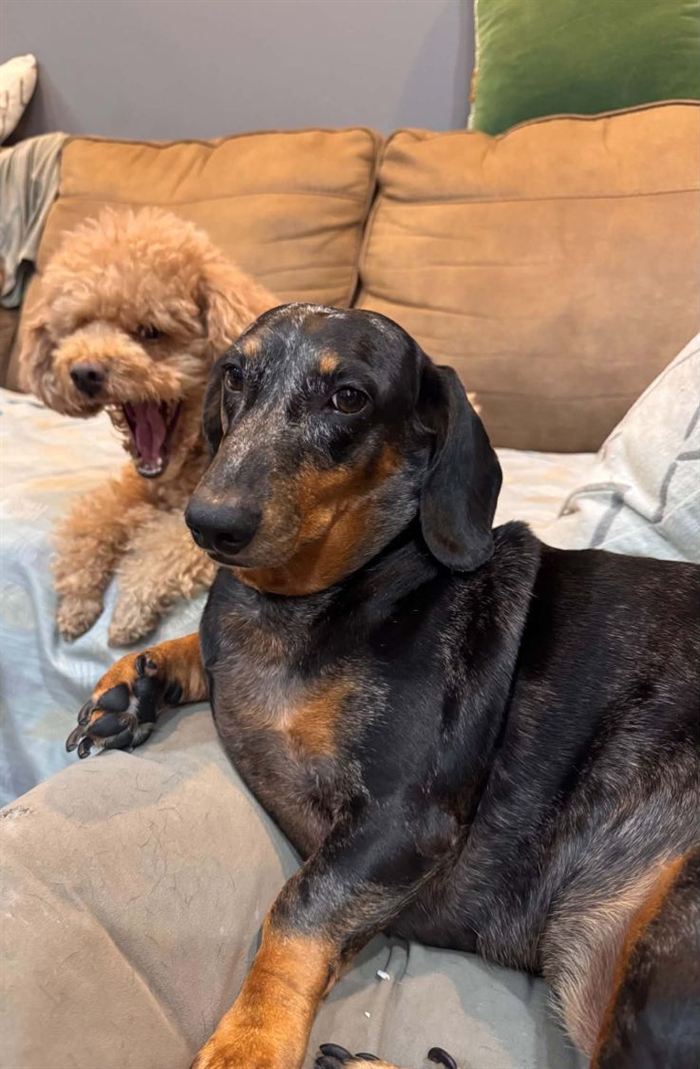
I also enjoy spending time with my two dogs: walking them, and playing with them at home.
About this website
This guide follows the IB Physics syllabus for first assessment in 2025. The notes, worked examples, diagrams and practice questions were written specially for this site, apart from the photographs credited below. They are not copied from textbooks or past papers. The site is not produced or endorsed by the International Baccalaureate Organization.
If you spot a mistake, please tell me in class.
Image credits
A few photographs show real experiments and events. They are shared by their authors under Creative Commons licences or are in the public domain. Each one is credited under the picture, and here:
- A.1 Bouncing ball: MichaelMaggs, edited by Richard Bartz, Wikimedia Commons, CC BY-SA 3.0.
- B.1 Thermal image of buildings: Passivhaus Institut, Wikimedia Commons, CC BY-SA 3.0.
- C.3 Single- and double-slit patterns: Jordgette, Wikimedia Commons, CC BY-SA 3.0.
- C.4 Tacoma Narrows Bridge: Barney Elliott, Wikimedia Commons, public domain.
- D.2 Iron filings around a bar magnet: Newton Henry Black and Harvey N. Davis, Practical Physics (1913), Wikimedia Commons, public domain.
- D.3 Fine-beam tube: Marcin Białek, Wikimedia Commons, CC BY-SA 4.0.
- E.1 Hydrogen spectrum: Jan Homann, Wikimedia Commons, CC BY-SA 3.0.
- E.3 Cloud-chamber tracks: Kebuk awan, Wikimedia Commons, CC BY-SA 4.0.
- E.5 The Sun: NASA/SDO (AIA), Wikimedia Commons, public domain.
- E.5 Hertzsprung–Russell diagram: ESO, Wikimedia Commons, CC BY 4.0.
- E.5 HR diagram with lines of constant radius: AstroOgier, Wikimedia Commons, CC0 (public domain).
Some photos have been resized to load quickly. Licences: CC BY 4.0, CC BY-SA 3.0, CC BY-SA 4.0, CC0.